

Harbour Energy is considering a staged clean-energy service pilot. This fictional example uses all six Future Matrix sections to move from uncertainty to reviewable responses, then check those responses against sample signals.
The Future Matrix was created by Julio Graham, who operates Olive Professional Services.
Review the six factor groups
Open Factor Analysis and look at grid connection delays, customer demand, delivery capability, partner readiness, office energy waste and internal reporting habits. The demo ratings are discussion assumptions.
Delivery capability and partner readiness sit in high control/high impact. Connection delays and customer demand sit in low control/high impact. Compare the reasons for those placements before using them to guide the next discussion.
Use the low-control/high-impact factors
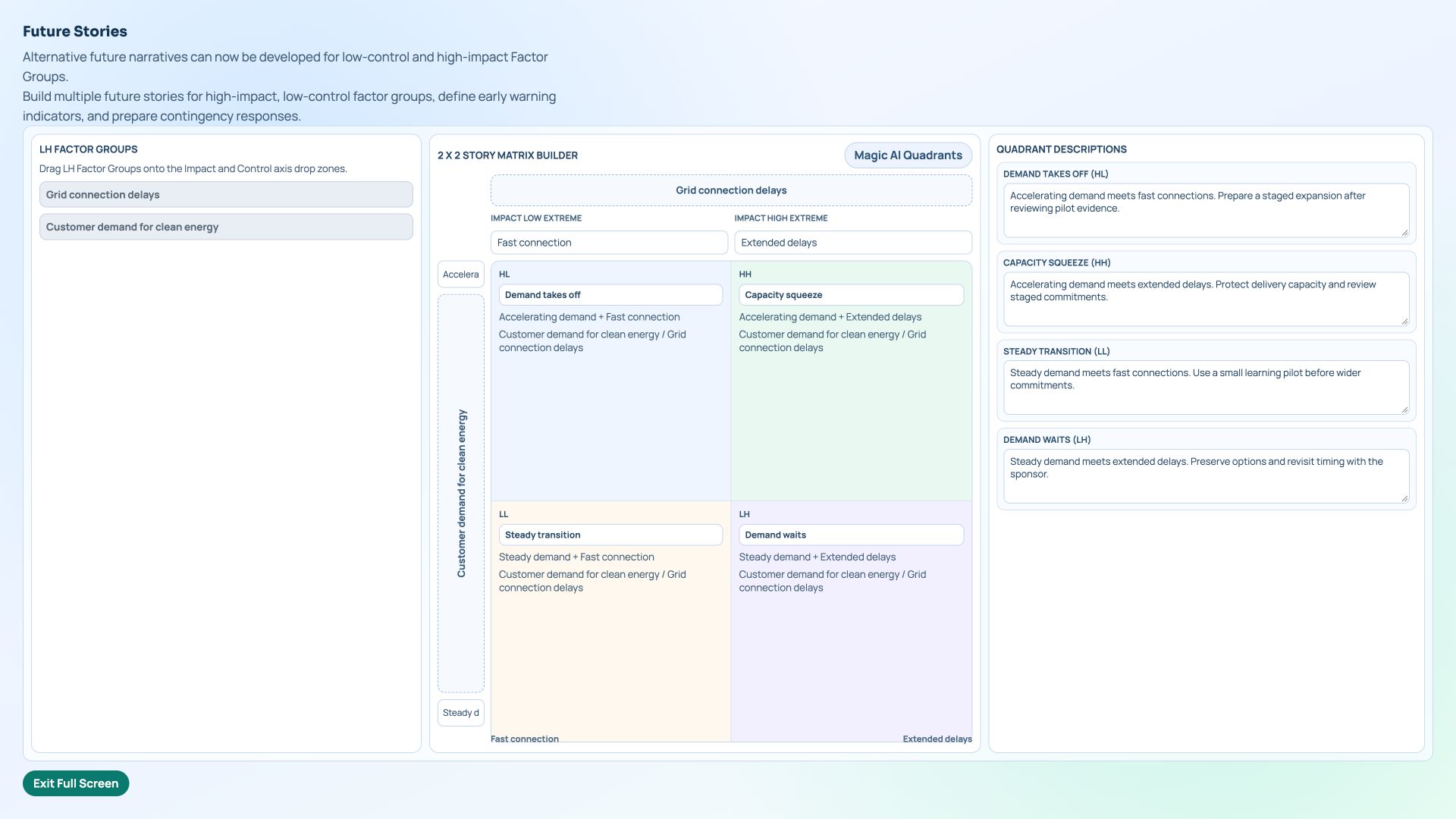
The two LH factors provide the dimensions for this example’s Future Stories.
- Choose Workshop Factor Analysis to review the notes, groups and matrix positions.
- Exit the workshop and select LH in the quadrant filter.
- Open Workshop Future Stories and inspect the selected factor groups for the two dimensions.
- Review the extremes: fast connection versus extended delays, and steady versus accelerating demand.
- Read each story’s name and description, then check that it corresponds to its combination of conditions.
Compare the stories and prepare a response
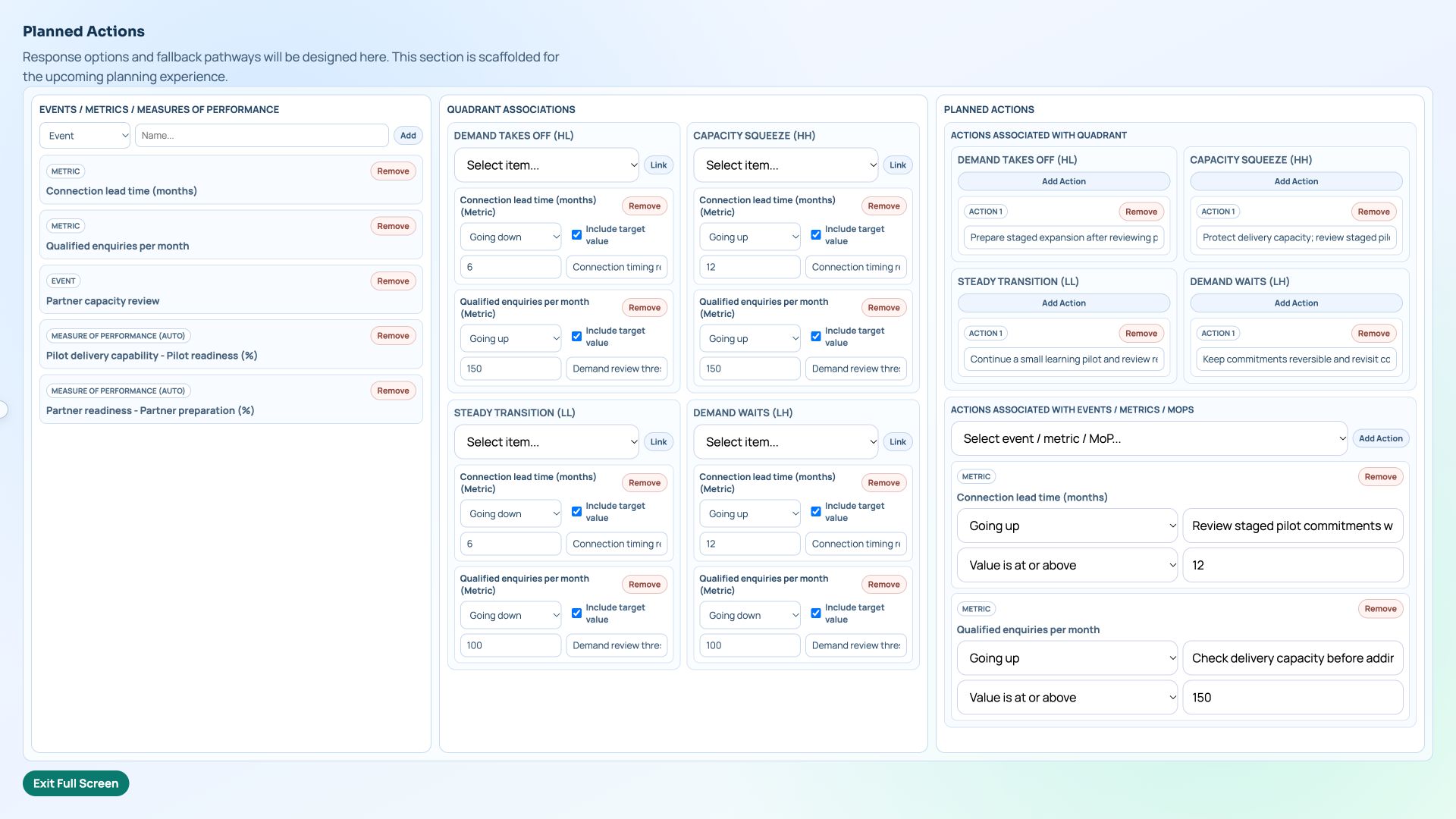
Open Workshop Planned Actions and compare the responses below. The same two factors define all four stories. A response should make sense for its combination of conditions; it is not an automatically approved delivery task.
| Future story | Conditions | Proposed response |
|---|---|---|
| Demand takes off (HL) | Accelerating demand + fast connection | Prepare staged expansion after reviewing pilot evidence. |
| Capacity squeeze (HH) | Accelerating demand + extended delays | Protect delivery capacity and review staged commitments. |
| Steady transition (LL) | Steady demand + fast connection | Continue a small learning pilot. |
| Demand waits (LH) | Steady demand + extended delays | Keep commitments reversible and revisit timing. |
Turn an assumption into a review rule
In Quadrant Associations, inspect Capacity squeeze. Connection lead time is Going up with a target of 12 months; qualified enquiries are Going up with a target of 150 per month. The individual metric actions below provide prompts to review pilot commitments and check delivery capacity.
For the contrasting fast-connection stories, lead time is Going down towards 6 months. Steady-demand stories use enquiries Going down towards 100. These are invented thresholds for trying the controls, not energy-market benchmarks. Partner capacity review is available as an event but has not been recorded as having occurred.
Keep controllable preparation visible with measures
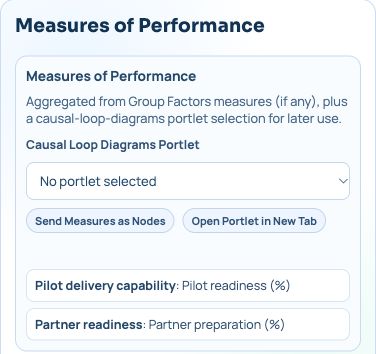
The Measures of Performance section lists Pilot readiness (%) and Partner preparation (%), entered against the corresponding factor groups. These describe preparation that the team can work on while external conditions remain uncertain.
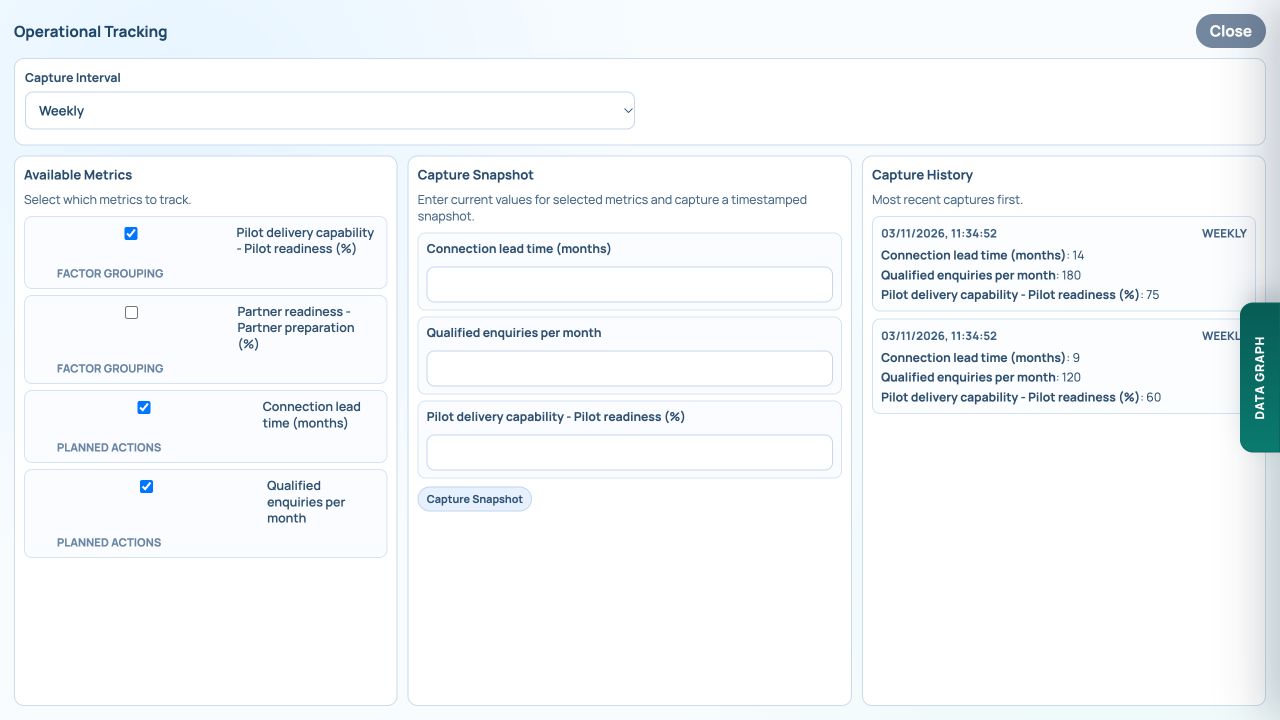
Open Operational Tracking and select pilot readiness alongside connection lead time and enquiries. Partner preparation is available but not selected. Readiness is tracked in this example without being linked to a story, so it does not contribute to the displayed affinity scores.
Capture two sets of sample values
The first demonstration capture uses lead time 9 months, 120 enquiries and 60% pilot readiness. The second uses 14 months, 180 enquiries and 75% readiness. Both were entered during the screenshot session; they do not represent two weeks of observed performance.
In Operational Tracking, enter each set and choose Capture Snapshot. The history shows the timestamp, interval label and values. Weekly records the intended review cadence; values are entered manually. Two captures let the trajectory view compare direction as well as the latest value.
Read the trajectory before changing the response
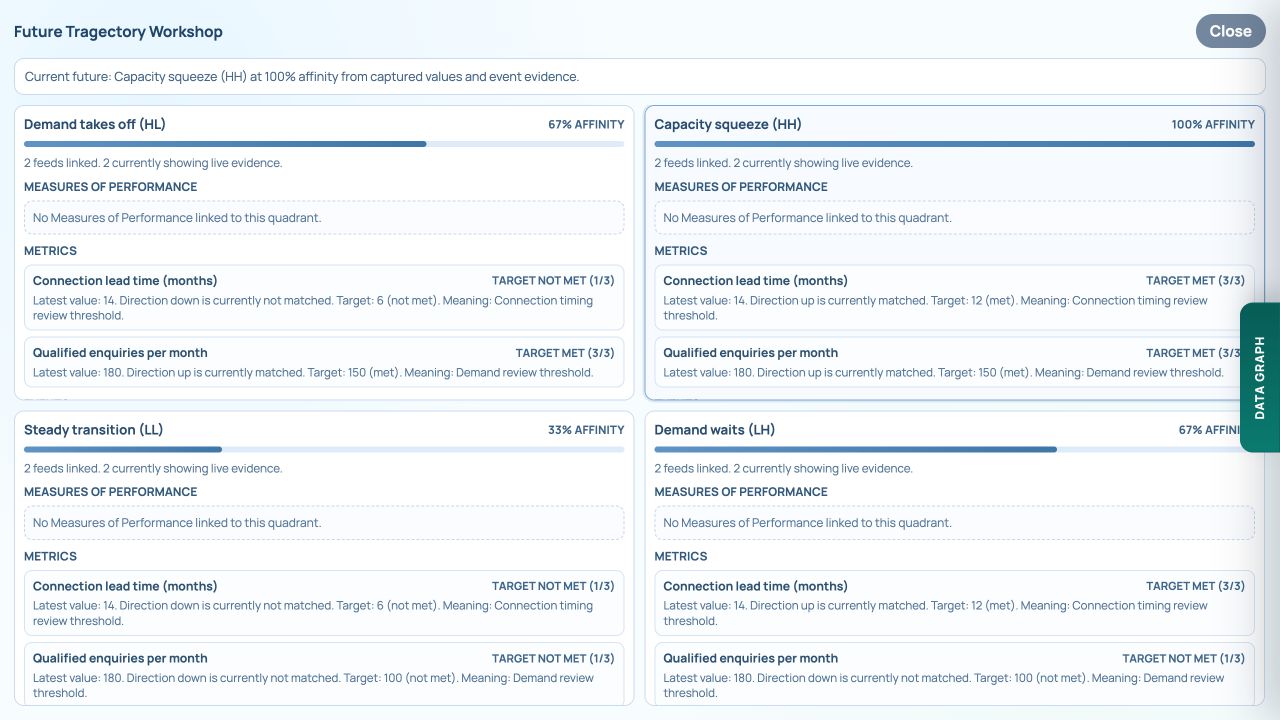
Open Future Tragectory Workshop. Capacity squeeze shows 100% affinity because both linked metrics have evidence, are moving in the specified direction and meet their configured targets. Openly inspect those rules with the workshop participants.
The score is a rule-match summary, not a 100% chance of that future. The other stories retain partial scores because some rule components still match. Use the explanation to decide whether a response needs review, then record any agreed change in Planned Actions.
Download future-matrix.json to inspect the complete fictional state, including stories, rules, group measures and the two captures. It is a state snapshot; check the module’s import workflow and use a separate example portlet before loading it.
Try it in your workspace
Try one alternative capture in a separate demo, inspect which direction and target rules match, and discuss whether the proposed response still fits.
Demo notes and files
The screenshots use the private CEP Blog · Field Notes workspace. The notes below identify the example portlets and downloadable files. Use your own permitted portlets to follow the steps.
See the demo notes ↗Download the Future Matrix state example ↓
This is part of an editorial retrospective. The archive date is not a feature release date; descriptions and screenshots reflect the November 2026 local demonstration. The examples are fictional.